
Peering into men’s health

Men's and boys' health is being made a topic of mainstream conversation in Canada, to help raise awareness about men's health concerns, their high rates of suicide, and the barriers they face when seeking access to all kinds of health care. As the federal Minister of Health, Marjorie Mitchell, assures, the initiative to create a national strategy on men's and boys' health "will encourage collaboration' on issues including mental health, addition, and public safety.
The national conversation has already benefited from contributions from advocates who are devoted to men's health and provide support and information through their websites. So it is disappointing to know that many of the websites to which men and boys (and girls and women) turn for help often contain hidden code that surreptitiously feeds detailed information about the user and about their interactions with the website to platforms such as TikTok and Meta (Facebook), long before the website called up appears on screen. Notably, a user does not have to have a Facebook account or be “simultaneously logged into TikTok and viewing a third-party website for our business tools to function.”
Being able to make a well-informed choice about whether or not to entrust sensitive information is important; but relying on website ‘privacy policies’ is risky business. They usually contain enough ambiguities and generalities that it’s almost impossible to understand what you’re consenting to when you click “I agree”.
Privacy policies that say your information “may be shared with our affiliates” reveals nothing about what organizations will receive what information, or what they might do with the data. And when one of those companies is breached, affected individuals might never know. An organization that has no direct relationship to the individuals whose information it holds often has no legal obligation to mention a breach to affected individuals.
Despite assurances that a company “is committed to protecting your privacy and the confidentiality of any personal information that you provide to us” — which might include tombstone, financial, medical, and contact information — it is perhaps surprising that health advocacy organizations so readily facilitate the monetization of personal and health-related information.
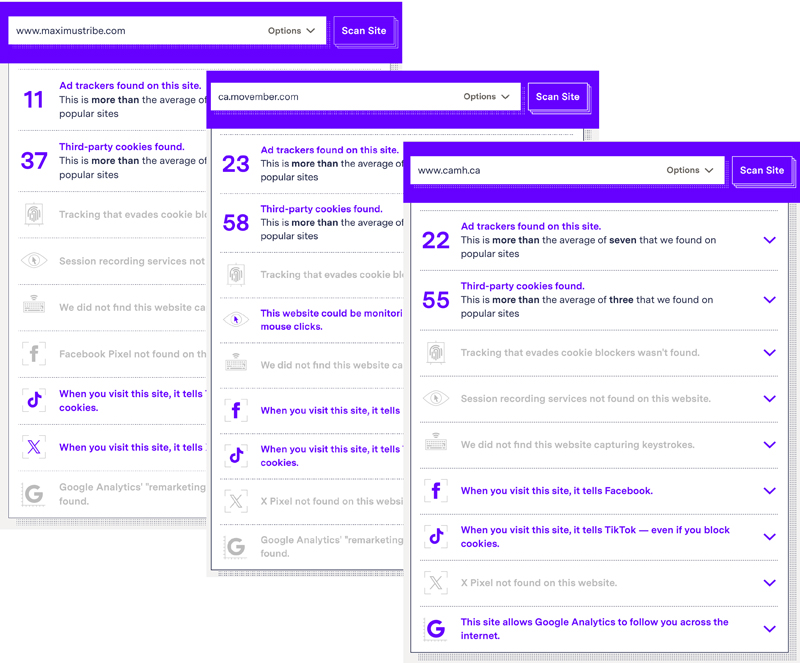
Whether by tracking the specific pages or content viewed, payment and purchase information, or by correlating the technical details about the device used to view a website, platforms can easily identity each visitor, discern their interests and concerns, and target them with personalized ads.
The problem afflicts more than men’s health and erectile dysfunction clinics, undermining clients’ privacy. Tracking technologies work in the background of websites run by organizations entrusted with sensitive personal information — including surgeons, retailers, lawyers, and mental health clinics — that one might reasonably expect would keep sensitive information confidential.
As lawmakers, regulators, and platforms continue to admonish the public to be careful where they entrust their personal information, the practice of covertly relaying data — that make it easy for platforms to correlate to an individual’s identity, discern their interests, and target them with personalized ads — now feeds a multi-billion-dollar industry that has become a vital organ of surveillance-based national economies.