
The Legacy Of Racism Behind The 'AIPAC Monkey' Slur
Anti-Black racism in the Arab world has a long and largely overlooked history that gives context to Rula Jebreal’s racist attack on Congressman Hakeem Jeffries.
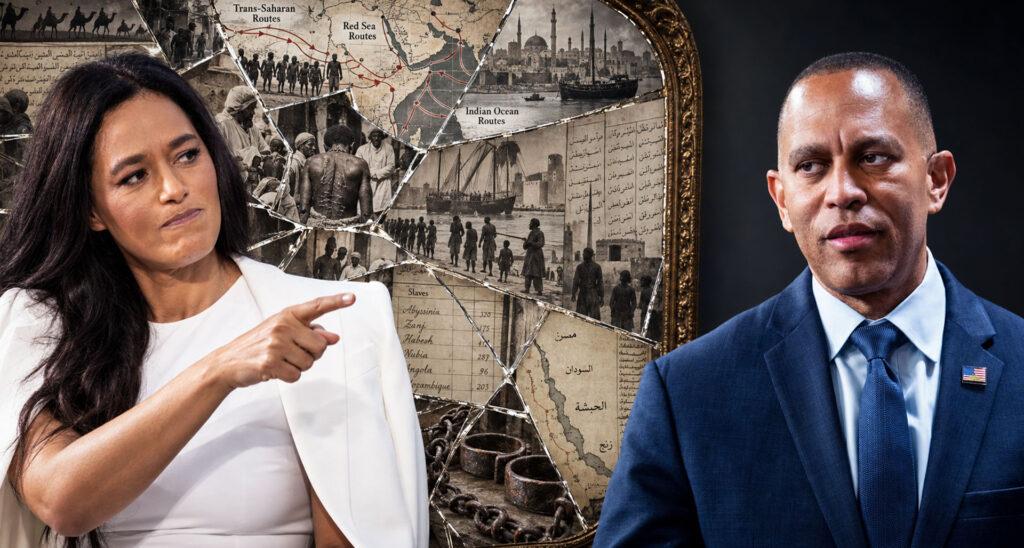
On September 4, on a podcast called The Left Hook, the Arab-Israeli journalist Rula Jebreal was asked about Hakeem Jeffries, the leader of the Democrats in the House of Representatives and the most senior Black politician in America. This is what she said:
“He is a bought-and-paid-for AIPAC monkey.”
Then, a moment later: “With all due respect, and I don’t mean it in a racist way. He is just basically an errand boy, and we’re done and tired.”
As a defense, Jebreal first said she had been thinking of the three wise monkeys. When that did not land, she apologized, saying the word “was inappropriate and offensive and should never have been used” and that she apologized “unconditionally.” Left Hook Podcast host Wajahat Ali, tagged in the criticism, replied that “we shouldn’t fall for divide and conquer and we must speak out against racism, Islamophobia and Israel’s ongoing genocide.”
The clip spread. The Congressional Black Caucus had responded: “To be clear, there isn’t a non-racist way to call Leader Jeffries, a Black man, a ‘monkey’ or ‘errand boy.’ We have to stop platforming and trafficking in anti-Black racism.” Congressman Ritchie Torres was shorter: “Calling a Black man a ‘monkey’ is racist. Full stop.”
Jebreal’s remarks are evocative of racial rhetoric bound to the history of slavery and inequality in the United States, but also raise questions about the Arab’s worlds own history on the same issues.
Racist rhetoric: “Boy” and “Monkey”
For most of American history, a white man could call a Black man “boy” to his face, at any age, in any setting. It was how a shopkeeper addressed a Black customer, how a police officer addressed a Black driver, how a foreman addressed a Black worker of sixty. It told a grown man that he was not one. Under slavery and then under Jim Crow, Black men were denied the ordinary markers of adulthood: the vote, the right to sit on a jury, the right to be called “Mister.” The word “boy” was the everyday version of that denial. This is why the striking sanitation workers in Memphis in 1968, the strike Martin Luther King Jr. was in the city to support when he was killed, carried signs that read “I AM A MAN.”
The point is so well established that the United States Supreme Court has said it. In Ash v. Tyson Foods in 2006, the Court ruled unanimously that a white manager calling Black employees “boy,” with no racial modifier attached, could by itself be racial hostility.
Comparing Black people to apes is the oldest and most consistent image in the history of anti-Black racism. It was the argument of the nineteenth-century race scientists who placed Africans between Europeans and chimpanzees on their charts. It was on the postcards and in the cartoons that sold Jim Crow to ordinary white Americans. It has been thrown, along with bananas, at Black footballers in European stadiums for fifty years. The image has one purpose: It says that the person in front of you is not fully human. Once someone is not fully human, anything can be done to them. That is why the image has survived every reform and every apology.
When a Black man is called a monkey and a boy, there is no ambiguity. It is not an unfortunate choice of words. It is the two most recognizable slurs in the American vocabulary of anti-Black racism, delivered together, on a podcast that describes itself as being of the left.
That is the American history, and it is why the reaction in America was immediate. But there is a second history behind these words, one that belongs to the Arab world, and it is older, longer, and far less known. It deserves to be told alongside the first.
The Other Slave Trade
Everyone knows about the Atlantic slave trade. Far fewer know that the Arab slave trade began roughly eight centuries earlier and ended much much later. Britain abolished slavery across its empire in 1833. The United States did so in 1865. Brazil, the last country to do so in the Americas, in 1888. Yet in the Arab world, the dates are within living memory. Qatar abolished slavery in 1952. Saudi Arabia and Yemen did so in 1962, the United Arab Emirates in 1963, Oman in 1970. Mauritania did not abolish it until 1981 and did not make it a crime until 2007. There are people alive today who were legally owned in Arab states.
From the seventh century onwards, enslaved Africans were taken across the Sahara, up the Red Sea and across the Indian Ocean into Arabia, Iraq, Egypt, the Maghreb and beyond. Historians such as Ronald Segal, in his 2001 book Islam’s Black Slaves, put the total number of Africans enslaved in this trade at a figure comparable to the Atlantic trade: somewhere in the region of eleven to fourteen million people over thirteen centuries. A large share of those taken were women and girls, bought for domestic labor and for sex. Many of the men and boys were castrated.
This is the part of the story that is least told, and it answers a question people rarely think to ask. The Atlantic trade left behind tens of millions of descendants in the Americas. The Arab trade took a comparable number of people over a longer period, into Arabia, Iraq, Egypt, the Maghreb and the Gulf. Where are their descendants? Why is there no Black population in the Middle East on the scale of Brazil’s, or America’s, or the Caribbean’s?
Male slaves were castrated in enormous numbers so that they could serve as eunuchs in courts, harems, and households, and so that they could not father children in the societies that owned them. The operation was carried out crudely, often by traders on the route north, without anesthesia and without any means of stopping infection. The majority of the boys and men it was performed on died of it. Bernard Lewis, in Race and Slavery in the Middle East (1990), notes that the very high price of a eunuch in the markets of the Islamic world reflected how few survived to be sold. Historians who have tried to count put the dead from the procedure alone in the millions.
So the answer to the question is a simple one. The descendants are not there because the men were mutilated and died, and those who lived could not have children. The women bore children to their owners, and those children were absorbed into Arab society, most often as Arabs.
Those who did survive did not accept it quietly. Between 869 CE and 883 CE, enslaved East Africans, known as the Zanj, rose against the Abbasid Caliphate in the salt marshes of southern Iraq. They had been worked to death draining the land around Basra. The revolt lasted fourteen years and took the caliphate’s armies to crush. It is one of the largest uprisings of enslaved people in recorded history.
Slavery in the Muslim world was not formally tied to skin color in the way it was in the Americas. In practice, it became so. Over centuries, Blackness came to be strongly associated with servitude in Arab societies, and the language followed.
The literature followed too. Lewis collects the descriptions of Black people that medieval Arab writers passed down as common knowledge. The fifteenth-century Egyptian scholar al-Abshihi wrote that the Black slave, if hungry, steals, and if full, fornicates. Others wrote that Black people were closer to animals than to men, that they were suited by nature to servitude, that they were stupid, or excitable, or smelled. These were not fringe views. They were the educated consensus of the age, and they sat comfortably beside a slave trade that ran for a thousand years.
The Arabic word for slave is abd (plural abeed). Across parts of the Arab world it remains a derogatory term for Black people.. Not a historical term. A word used in the street, in jokes, in the schoolyard. In Morocco it shares the job with khadem, servant.
Nobody is exempt. Anwar Sadat, the president of Egypt who made peace with Israel and won the Nobel Prize for it, was dark-skinned, the son of a Sudanese mother. To his critics at home he was “Nasser’s black poodle,” a man who did not look Egyptian enough. The most powerful Black man in the Arab world was, in the end, a poodle. In America, half a century later, the most powerful Black politician is an errand boy.
Continuing Today
In parts of the Arab world, this has not ended at all.
The Global Slavery Index, compiled by the Walk Free Foundation with the International Labour Organization, ranks countries by the share of their population living in modern slavery. In its 2023 edition, four of the ten worst countries on earth were Arab states: Mauritania in third place, Saudi Arabia fourth, the United Arab Emirates seventh, Kuwait tenth. The Arab States region had the highest prevalence of any region in the world.
Mauritania is the clearest case. Abolition on paper in 1981 changed very little. The index estimates that around 150,000 people there, roughly one in thirty, live in slavery today. Most are Haratin, but many are Black Mauritanians descended from the enslaved who are born into bondage to Arab-Berber masters. They inherited that status from their mothers, and can be given away, lent, or sold. Anti-slavery activists in the country have been jailed for protesting the issue. Across the Maghreb and the Sahel, the same hierarchy holds: lighter-skinned Arab and Berber elites above, Black populations who were property below.
In Sudan, during the civil war that ran from 1983 to 2005, Arab militias armed by the government in Khartoum raided Black African villages in the south and took women and children as slaves. Tens of thousands were abducted. Some were later bought back by charities. Many never came home.
In Libya, during the 2011 uprising against Gaddafi, Amnesty International documented rebel forces killing Black Africans, migrants and Black Libyans alike, on the theory that any Black man must be a mercenary. The town of Tawergha, home to around thirty thousand Black Libyans, was emptied entirely, and its people have not been allowed back. Six years later, in 2017, CNN filmed Black African migrants being auctioned as slaves outside Tripoli for a few hundred dollars each. The footage went around the world for a week. Then the world moved on.
In Yemen, the Muhamasheen, “the marginalized,” a Black minority of several hundred thousand people better known by the slur akhdam, servants, have been confined for centuries to the bottom of the social order: street sweeping, refuse collection, slums on the edges of cities. Marriage to them is treated as a disgrace. A Yemeni proverb, still repeated, has it that if a dog touches your plate you wash it, and if an akhdam touches it you break it.
And in the Gulf, the kafala system ties millions of African and Asian workers to a single employer who holds their passport, controls whether they can leave the country, and in practice decides whether they are paid. Human rights groups have described it as slavery under another name for two decades. It is still the law.
The Neighborhood of the Slaves
Slavery is the extreme. The everyday version is everywhere, and it includes the Palestinian society that the Western left has spent two years holding up as the moral center of the world.
In Gaza City, in the al-Jalaa district, there is a neighborhood called Harat al-Abeed. It translates as the neighborhood of the slaves. It is poor. It is still called that. Nobody has renamed it, and nobody has seriously tried.
The people who live there have described their lives to journalists on the rare occasions anyone has asked. A young man named Mohammad Obaid told Gulf News that he had to “prove myself twice as much as others,” that Black Gazans are kept out of jobs where they would be seen by customers, and that when a Black man wants to marry a lighter-skinned woman, her family’s answer can be public humiliation. He described a groom’s father threatening to disown his son in the newspapers over such a match. A Black woman marrying a lighter-skinned Palestinian man is rarer still. He said he was the one passenger pulled aside at checkpoints run by his own people, and he wrote a poem about it. Its title was “Blacks are not security suspects.”
In Jerusalem’s Old City there is an African Quarter too, by the Bab al-Majlis gate, where Afro-Palestinians have lived for generations. Its residents have told the same story for decades: that in the street they are called abeed, slaves, and that their neighborhood is known to other Palestinians as “the slaves’ prison.”
And it is not only Palestinians. Every Ramadan, Arab television networks broadcast comedies in which Arab actors perform in blackface, with padded lips and exaggerated accents, playing Black characters, usually Sudanese, as servants and fools. Kuwait’s Block Ghashmara did it in 2018. Egypt’s Samir Ghanem and his daughter Amy did it in Azmi we Ashgan. One of Lebanon’s biggest pop stars, Myriam Fares, did it in a music video. In the summer of 2020, at the height of the Black Lives Matter protests, several Arab celebrities posted photographs of themselves in blackface as a gesture of solidarity, and were baffled to be told it was offensive. In Egyptian football, the star Shikabala, who is of Nubian origin, was driven to walk away from the national team by racist abuse from the stands, and years later fans were arrested for parading a black dog in a white shirt and chanting his name at it. In Lebanon, tens of thousands of African domestic workers live under the kafala system in private homes, and the rate at which they die, by suicide or by falling from balconies, has been documented by human rights groups since the 2000s. In Egypt, Sudanese and other Black African refugees describe being called “slaves” in the street as a routine part of daily life.
The clearest recent case is Tunisia, and Tunisia had tried. In 2018 it became the only country in the region to make racial discrimination a crime. Five years later, in February 2023, President Kais Saied told his National Security Council that there was “a criminal arrangement” to change the “demographic composition” of Tunisia by settling sub-Saharan Africans there, with the goal of making Tunisia “an African country and not belonging to the Arab and Islamic nations.” A head of state had endorsed the Great Replacement theory, aimed at Black people. Within days, landlords evicted Black tenants, employers sacked Black workers, people threw stones at Black women in the street, and hundreds of Black migrants were camped outside their embassies waiting to be flown out. The African Union condemned him. The Western left, which had spent years explaining that the Great Replacement is a fascist idea, said almost nothing.
It is one of the most consistent features of anti-Black racism in the Arab world that it is treated, by Arabs and by their Western sympathizers alike, as not really racism. It is called colorism, or a joke, or a cultural difference, or a word that does not mean what it means. Surveys by Arab Barometer, the region’s largest independent polling network, find that in almost every Arab country polled, only a minority of citizens think discrimination against Black people is a serious problem at all. When a Canadian academic wrote about the work of the Bahraini scholar Nader Kadhim, who has spent his career on the subject, the response from Arab readers was “Why are you vilifying our culture?” The standard reply, when it is raised, is “I don’t see color.”
A Legacy of Colonization
There is a larger frame around all of this, and the Western left never looks at it.
North Africa was not always Arab. Before the seventh century it was Amazigh, or Berber, and Egyptian, and Nubian, and much of it was Christian. Between 639 and 711, Arab armies conquered it from the Nile to the Atlantic. The progressive spread of Arabic at the expense of indigenous languages, and widespread Arabization of local populations
Nubia, in what is now Sudan, was a Christian kingdom when the Arabs arrived. In 652 it signed a treaty with the new rulers of Egypt, the Baqt, under which Nubia was required to deliver several hundred slaves to Egypt every year. It was a tribute paid in human beings, and it ran for five centuries. Sudan was Arabized from the north downwards, and the line between Arab and African that was drawn then is the line along which Sudan has been killing itself ever since.
On the east coast, Omani Arabs made Zanzibar the largest slave market in Africa. Through the nineteenth century, tens of thousands of Africans a year were marched to the coast from the interior and shipped north. It was the British, not any Arab power, that finally forced the Zanzibar market closed in 1873.
This is what colonization looks like. A foreign power arrives by force, takes the land, replaces the language, replaces the religion, replaces the name of the people, and puts the natives to work. By any definition the Western left uses when it talks about Europe, the Arab conquest of North Africa was one of the largest and most lasting colonial projects in history. It is simply never called that. The Arab world is permanently cast as the colonized and never as the colonizer, and half of Africa is written out of the story to make the casting work.
And it is not over. The frontier between the Arab-Islamic world and Black Africa is the most violent place on earth today, and the violence runs one way.
In Nigeria, according to Open Doors’ 2026 World Watch List, 3,490 Christians were killed for their faith in a single year. That is seventy-two percent of every Christian killed for their faith anywhere in the world. The killers are Boko Haram, the Islamic State’s West Africa Province, and armed Fulani militants who have been emptying Christian farming villages across the Middle Belt for a decade. In 2014 Boko Haram took 276 schoolgirls from Chibok. Some are still missing.
In the Sahel, jihadist groups tied to al-Qaeda and the Islamic State control large parts of Mali, Burkina Faso and Niger. In August 2024, in Barsalogho in Burkina Faso, they killed several hundred villagers in a single afternoon. In northern Mozambique, an Islamic State affiliate has been beheading villagers in Cabo Delgado since 2017 and has driven around a million people from their homes. In Somalia, al-Shabaab has been doing the same for nearly twenty years.
And in Sudan, the line drawn in 652 is being enforced again. In 2023, in El Geneina in West Darfur, the Rapid Support Forces and allied Arab militias killed between ten and fifteen thousand people of the Masalit, a Black African ethnic group, in a matter of months. Human Rights Watch recorded what the killers said as they worked: that the Masalit were “slaves,” that “no slaves will live here,” that the land would be “cleaned” to become “the land of the Arabs.” In January 2025 the United States formally determined that the RSF had committed genocide. The same word, abd, was on the lips of the men doing the killing.
None of this produced a march. None of it produced an encampment on a university lawn. The people who can find Gaza on a map with their eyes closed could not tell you where El Geneina is. Black Africans killed by Arabs, or by Islamists, do not count. They never have.
What it Reveals
Look at what Jeffries actually did to earn this. He supported Israel. That is the whole charge. For that, the most powerful Black politician in America was reduced to a bought animal running errands for Jews.
The Black man cannot have his own views. He must have been purchased. And who purchased him? The Jewish lobby. It is anti-Black racism and Jew-hate in a single sentence, each one holding the other up. The Jew is the puppeteer. The Black man is the puppet. Neither is a full human being.
This is not new either. It is the oldest trick there is: set the two groups you despise against each other, and stand back.
Jebreal has apologized. But an apology for the word is not an apology for the thinking, and the thinking is what produced the word. Until the people who use the language of justice are willing to turn it on their own history, we will keep hearing “I don’t mean it in a racist way” from people who do not know what they mean at all.
The Congressional Black Caucus said it plainly. There is no non-racist way to say it. There never was.
Ben M. Freeman writes for HonestReporting.com. He is the founder of the modern Jewish Pride movement. He is the author of Jewish Pride: Rebuilding a People (2021) Reclaiming our Story: The Pursuit of Jewish Pride (2022) and The Jews: An Indigenous People (2025). His work focuses on Jewish identity and historical and contemporary Jew-hatred. A Holocaust scholar for over fifteen years, Ben came to prominence during the Corbyn Labour Jew-hate crisis in the UK and quickly became one of his generation’s leading Jewish thinkers and voices against Jew-hate.