
Canada's Assisted Suicide Crisis
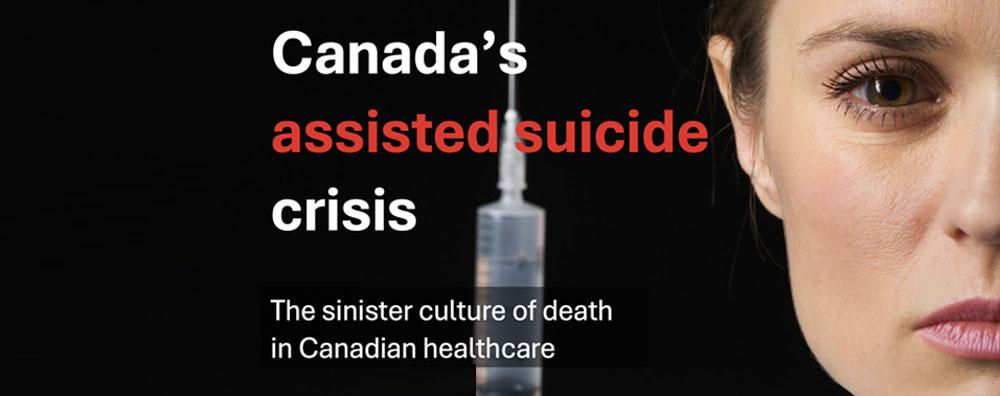
With its 2015 Carter v. Canada decision, the Supreme Court of Canada opened the door to Canada’s assisted suicide regime. It carved a narrow constitutional exemption to the Criminal Code’s emphatic and longstanding prohibition on medically assisted suicide. Parliament soon followed this by officially legalizing the practice with Bill C-14 in 2016.
The Court emphasized that exceptions must be “stringently limited” and accompanied by robust safeguards, particularly the requirement of contemporaneous, voluntary, and informed consent by a competent adult at the time the procedure is performed.
These principles were the moral foundation upon which the regime rested.
A decade later, that moral foundation is in doubt.
Assisted suicide in Canada has expanded far beyond its original scope, both in frequency and ambition. In 2024, it became the fourth most common cause of death in Canada, accounting for 5.1 percent of all deaths (7.9 percent in the province of Quebec!), which is second only to the Netherlands at 5.8 percent of all deaths in 2024.
More troubling yet are two conversations potentially altering the nature of consent itself, and redefining end-of-life decision-making.
The first is the growing advocacy for “advance requests” for assisted suicide, where a competent individual would be permitted to pre-authorize their future euthanasia, even and especially in cases where they should later lack capacity to understand, confirm, or revoke that decision. Often presented as “prudent planning,” advance requests actually sever the link between consent and the act that follows.
The second and even more disturbing development is the emerging professional discourse that contemplates euthanasia without consent, or “involuntary euthanasia."
Testimony to parliamentary committees has included suggestions that infants with severe disabilities, or elderly individuals perceived as “failing to thrive,” might be candidates for euthanasia despite being incapable of consent. Such proposals signal a shift from autonomy as the governing principle of assisted suicide, towards others assessing whose lives are deemed worth continuing.
These two developments represent a profound departure from the intent of the Carter decision, Parliament’s stated objectives, and from the Charter’s protection of life, liberty, and security of the person. A system permitting death without contemporaneous, informed consent no longer safeguards freedom; it manages vulnerability without regard for these safeguards. The risk is not merely error or abuse, but a normalization of deliberately causing death as a response to dependency, suffering, or social failure.
Canada urgently needs to provide life-affirming responses to end-of-life suffering. Many Canadians nearing death do not want or seek assisted suicide. Rather, they seek relief from pain, loneliness and isolation, and they desire environments affirming the value of their lives until natural death. Yet access to comprehensive high-quality palliative (near- death) care remains inadequate across the country.
Defending end-of-life freedom and dignity in Canada requires legislative and policy changes to establish clear, principled limits. Governments must reaffirm contemporaneous informed consent as the non-negotiable condition of assisted suicide, reject all non-consensual euthanasia, protect suicide-free spaces for those wanting them, and prioritise palliative care as the compassionate response to suffering.
Otherwise, dignity risks being replaced by expedience, and the Charter right to life will vanish at the most vulnerable moments of human life.